Bonfire Terminal vs Google Colab: The MCP Ecosystem Showdown
Larry's Verdict
Google Colab is another cloud-dependent AI tool that does exactly one thing and charges you monthly (or per-token) for the privilege. Bonfire Terminal is a one-time purchase that replaces your entire marketing stack — video, images, websites, ads, SEO, automation, copywriting — all running locally with Alpha AI. No cloud. No subscriptions. No API bills.
What Is Google Colab?
Google's hosted Jupyter notebook environment with free GPU/TPU access. Great for ML experimentation but limited runtime and cloud-dependent.
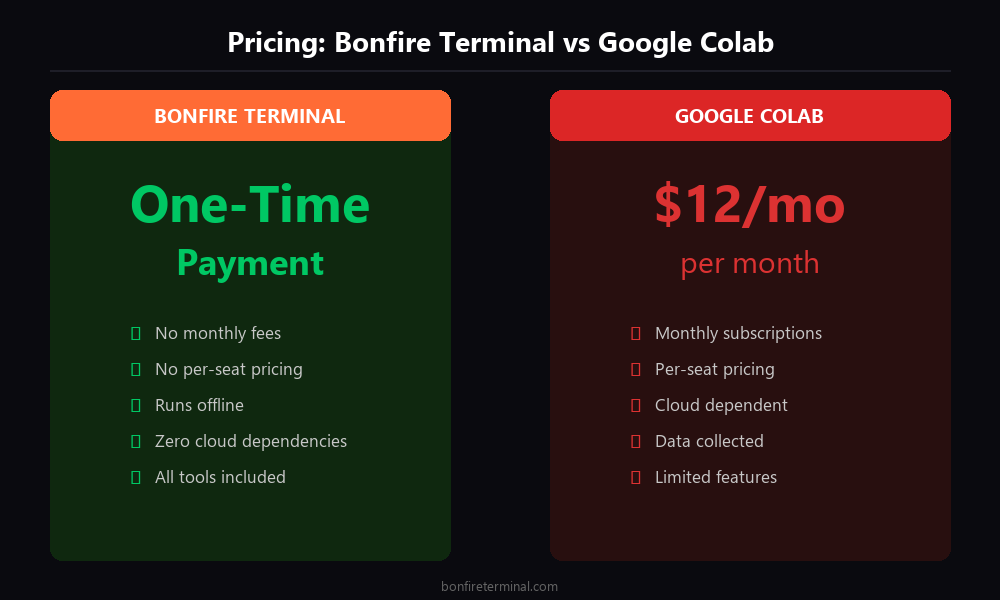
Pricing: Free tier, $12/mo Pro, $50/mo Pro+.
That's $144 per year just for Google Colab. And it only does one thing — code assistance. It doesn't create videos, generate images, build websites, run ad campaigns, or do SEO.
What Google Colab Actually Offers
- Free GPU access
- Jupyter notebooks
- Google Drive integration
- Pre-installed ML libraries
- Collaboration features
- T4/A100 GPU options
Useful for developers? Sure. But it's a single-purpose tool in an era where Bonfire Terminal gives you an entire AI-powered marketing operation for a one-time payment.
The Problem With Google Colab
I've evaluated Google Colab against what modern marketers and entrepreneurs actually need. Here's where it falls short:
- Free tier has 12-hour runtime limits and frequent disconnects
- Pro plan $12/mo still has significant compute caps
- Cloud-only — no local execution or offline mode
- Not a development environment — just notebooks
- No marketing, video, image generation, or SEO tools
- Google monitors and can terminate your sessions
What Bonfire Terminal Does Instead
While Google Colab focuses narrowly on AI-assisted coding or chat, Bonfire Terminal replaces your entire marketing tool stack:
- Alpha AI Agent — Multimodal AI that creates videos, images, websites, ad campaigns, and copy from a single terminal
- Video Editing — AI-powered video creation and editing, no Premiere Pro subscription
- Image Generation — Create marketing assets without Canva or Photoshop subscriptions
- Website Building — Build and deploy sites without WordPress hosting fees
- SEO Tools — Full audit and optimization without Ahrefs/SEMrush subscriptions
- Ad Management — Create and manage campaigns across platforms
- Workflow Automation — Replace Zapier and Make with built-in automation
All of it runs offline on your machine. One purchase. Zero cloud. Zero telemetry. Zero monthly fees.
Feature-by-Feature Comparison
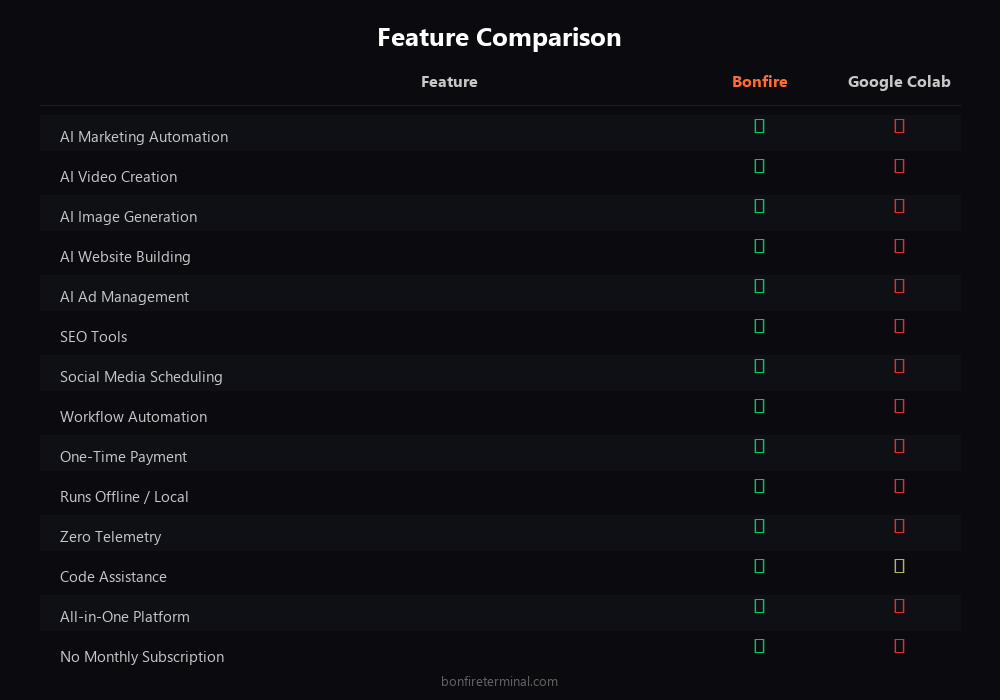
| Criteria | Bonfire Terminal | Google Colab |
|---|---|---|
| Pricing | One-time payment | $12/mo |
| Marketing Tools | Video, images, ads, SEO, copy | Code/chat only |
| AI Agent | Alpha — full marketing AI | Limited to code tasks |
| Runs Offline | Yes — fully local | Cloud-dependent |
| Data Privacy | Zero telemetry | Data sent to servers |
| Video Creation | Built-in | Not included |
| Image Generation | Built-in | Not included |
| Website Building | Built-in | Not included |
| Per-Seat Pricing | No — unlimited | Per-seat / per-token |
The MCP ecosystem costs you:
The MCP Trap
The entire MCP ecosystem — whether it's OpenAI's Codex, Google's Gemini tools, or Anthropic's Claude suite — follows the same playbook: give you a narrow capability, charge monthly or per-token, keep your data in the cloud, and lock you into their ecosystem.
Google Colab is just one node in this cloud-dependent matrix. You need Google Colab for coding, plus Canva for images, plus Premiere for video, plus HubSpot for marketing, plus Zapier for automation. That's $5,000-10,000/year in subscriptions.
Bonfire Terminal replaces the entire stack. One terminal. One payment. Zero cloud dependencies.
The Bottom Line
Google Colab does one thing and charges you perpetually for it. Bonfire Terminal does everything — video, images, websites, ads, SEO, automation, copywriting — for a one-time payment, running entirely on your local machine with zero cloud dependencies.
Stop renting AI tools. Own the whole terminal.
FAQ
Escape the MCP Subscription Trap
Replace Google Colab and your entire monthly tool stack with one terminal.
Learn More at Bonfire Terminal →